
English 
Zhengfeng Road, Licheng District, Jinan City, Shandong Province,China
Author: Alex Song Publish Time: 2026-10-22 Origin: Site
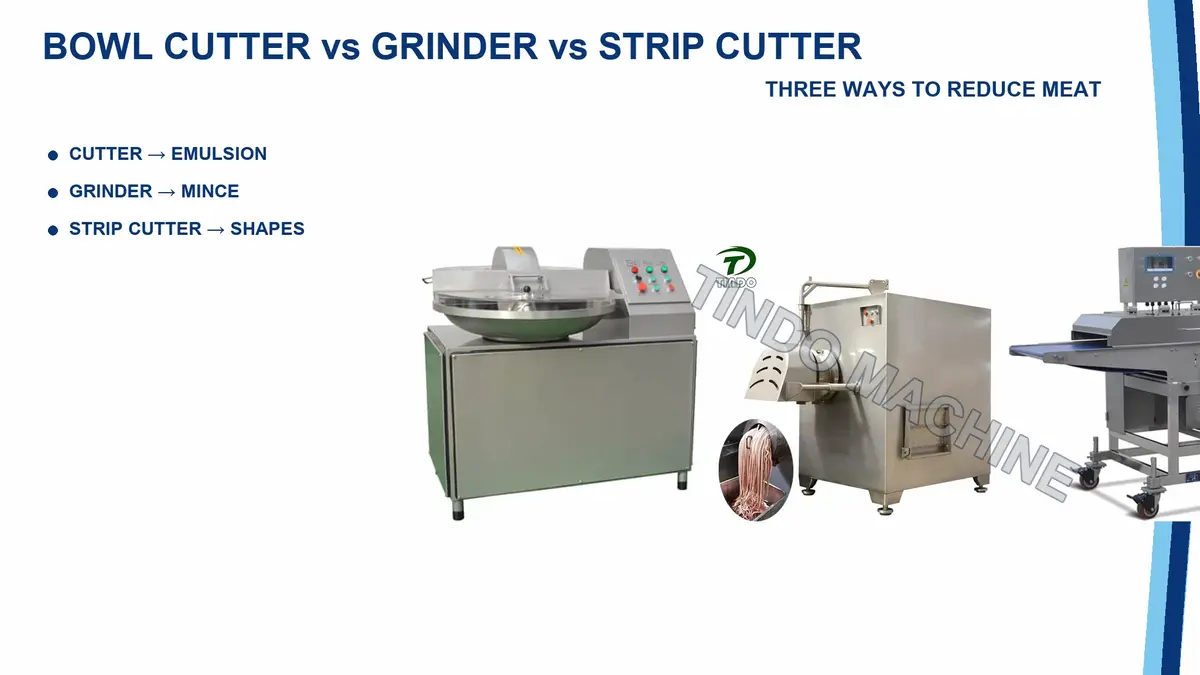
These three machines are treated as a category — "size reduction" — and then compared as if they were three grades of the same operation. They are not. Each one produces a fundamentally different material, and the downstream line is built around that material. Choosing between them is not a question of capacity or budget. It is a question of what you are making.
A bowl cutter produces an emulsion. Product turns in a bowl while a head of 3 to 6 high-carbon stainless steel blades rotates at speed through it. The blades and bowl run on independent variable-frequency drives, so blade speed and bowl speed are set separately — which is the control that decides whether the batch becomes a coarse paste or a fine, stable emulsion. The output is a single homogeneous mass. Frankfurters, mortadella, liver pastes and spreads all begin here.
A grinder produces discrete particles. Product is forced by a screw through a perforated plate. What comes out is mince: separate pieces of a known size, with the fat and lean still distributed as pieces rather than blended. Our JR series industrial grinders cover 600–1,000 kg/h at the JR-120 up to 4,000–5,000 kg/h at the JR-300, and the machine's output is defined entirely by which plate is fitted.
A strip cutter produces shapes. Whole cuts are conveyed past a cutting head and come out as slices or strips of a set thickness. Nothing is minced and nothing is emulsified — the piece stays a piece. Our dual-channel strip cutter runs two independent channels at up to 120 pieces per minute, with cutting thickness adjustable from 2.5 mm to 50 mm and up to 8 layers cut simultaneously.
This is the single most useful thing to understand about the three.
| Machine | What defines output size | Working range |
|---|---|---|
| Grinder | Plate hole diameter | 3–5 mm fine, 6–8 mm medium, 10–13 mm coarse, 16–20 mm extra coarse |
| Bowl cutter | Gap between blade and bowl, plus speed | Below grinder range — down to emulsion |
| Strip cutter | Set slice thickness on whole cuts | 2.5–50 mm, on intact pieces |
A grinder cannot make an emulsion, because the plate is a sieve and a sieve has a floor. A bowl cutter can go below grinder fineness, but it does so by blending everything together, so it cannot produce discrete mince. A strip cutter does not reduce particle size at all — it changes the geometry of a piece whose internal structure is untouched.
Put differently: a grinder and a bowl cutter are on the same axis, one coarser and one finer. A strip cutter is on a different axis entirely. That distinction decides most real specifications.
Reduction work puts energy into the product, and the product is food.
Bowl cutting is the most heat-intensive of the three. The blade head turns at high speed in a dense load, and the resulting temperature rise is the classic reason a batch loses its bind or turns grey. This is why bowl cutter specification is really temperature-management specification — blade geometry chosen to limit friction, precise speed control so the operator does not have to run flat out the whole cycle, and in some cases vacuum. Our meat bowl cutter offers an optional vacuum system specifically for this: removing air prevents the oxidation that dulls colour and reduces the bubbles that weaken an emulsion.
Grinding generates less heat per kilogram than bowl cutting, but it has its own thermal limit — the minimum grinding temperature. The JR-120 and JR-130 are built for product at 0 to −5 °C, the JR-160 reaches −10 °C, and the models built for frozen blocks run from −5 to −18 °C without pre-thawing. Grinding frozen product below a machine's rated minimum is how you get a stalled screw and a burnt drive, not a finer grind.
Strip cutting is the coolest of the three because it is a single clean pass with minimal contact area. That is also why it is the only one of the three that can run on a whole cut and leave it looking whole.
Bowl cutter. Right for sausages, frankfurters, pastes, spreads and fillings, and for any product where the fat, lean and seasoning have to become one continuous phase. Wrong for anything where you want to see what the meat was — a bowl cutter destroys visible structure, and once the batch is over-chopped the texture cannot be recovered.
Grinder. Right for burger patties, meatballs, breakfast sausage, fresh sausage, chili and pet food — products where discrete particles are the point, and where a defined, repeatable particle size is the specification. Wrong as a substitute for a bowl cutter: running mince through a grinder repeatedly does not emulsify it, it just produces finer mince with more smear.
Strip cutter. Right for products sold as pieces — poultry strips, sliced beef for stir-fry or hotpot, jerky base, kebab and skewer stock, and any line where the whole-cut appearance is the product. Wrong wherever the downstream process needs uniform small particles; a strip cutter preserves structure, so it is also the one machine that has to be matched to how the meat is presented to it.
The three are complementary far more often than they are alternatives, and the sequence follows from what each output can feed.
There is a fourth route worth knowing about, because it sits outside this group: shredding. A meat shredder takes cooked product and separates it into fibres rather than reducing it to particles or strips, which is what pulled and flossed products need. It is fed after cooking, not before, so it does not compete with the three above.
Can a grinder make fine sausage emulsion? Not by itself. The plate sets a floor on particle size, and repeated grinding produces smear rather than emulsion. Emulsified sausage is made on a bowl cutter.
Can a bowl cutter replace a grinder? Only for products where discrete particles are not wanted. If the specification mentions a plate size, the customer is describing mince, and that is a grinder's output.
Which one do I need first? Start from the finished product. If the product is a piece, it is a strip cutter. If it is a formed patty or a fresh link, it is a grinder. If it is a frankfurter, a paste or a spread, it is a bowl cutter.
Does the strip cutter work on frozen product? Yes — the range covers fresh and frozen poultry, beef, pork, lamb and fish, with cutting thickness from 2.5 mm to 50 mm and conveyor widths of 2×165 mm, 260 mm or 500 mm depending on configuration.
What about capacity — is one more productive than another? The scales are not comparable, which is why headline figures mislead. A strip cutter is rated in pieces per minute, a grinder in kg/h, and a bowl cutter in batch volume. Compare each against the rate your line actually needs at that stage, not against each other. The bowl cutter range page lists the available capacities.
Which machine causes the most temperature rise? Bowl cutting, because of the blade-to-product contact at high speed in a dense load. That is why it is the machine of the three where temperature control, speed control and sometimes vacuum are part of the specification.
