
English 
Zhengfeng Road, Licheng District, Jinan City, Shandong Province,China
Author: Alex Song Publish Time: 2026-10-15 Origin: Site
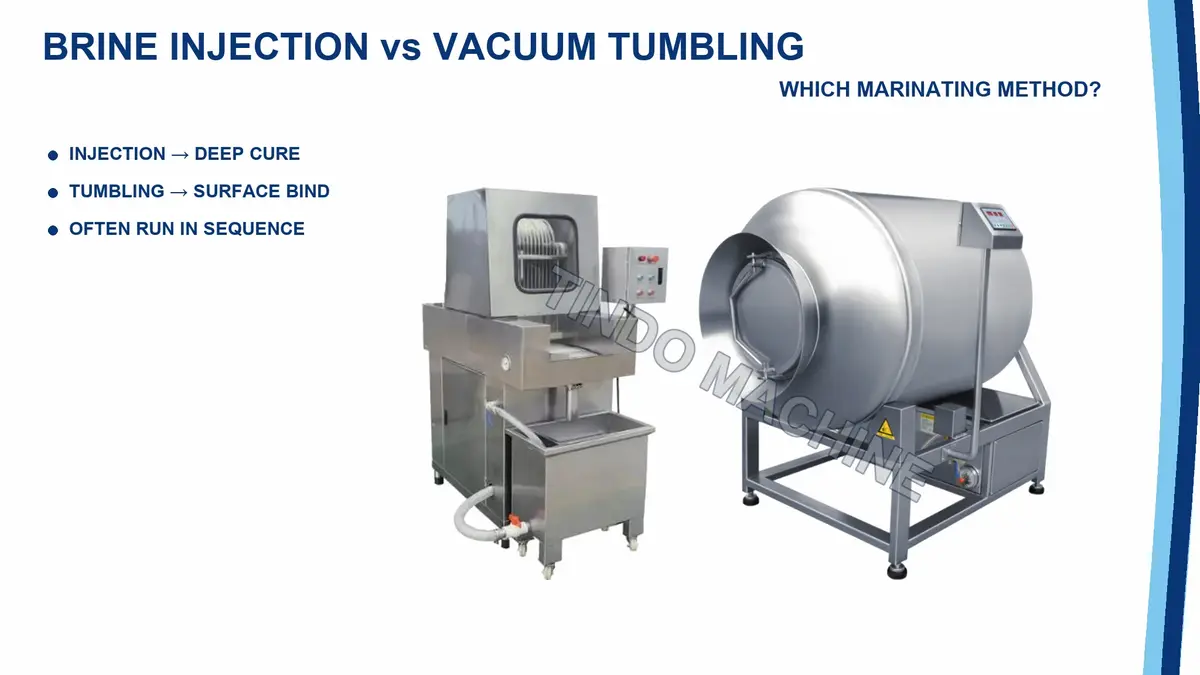
There are two established ways to get brine into a piece of meat, and they are not variations of the same idea. One pushes liquid into the interior of the cut with needles. The other works liquid in from the surface while the meat turns in a drum. Buyers often ask which one to install first. The honest answer is that they solve different problems, and the deciding factors are the cut, the casing of the final product, and how deep the seasoning has to go.
Needle injection. A brine injector moves the product under a bank of hollow needles on a step conveyor. Each needle delivers brine at pressure into the interior of the cut. On our ZSJ series brine injectors the working pressure is adjustable between 0.2 and 0.6 MPa, with 36 injection strokes per minute and a choice of 3 mm or 4 mm needles. Step speed, step distance and injection pressure are all set independently, which is what lets one machine cover pork loin and a whole chicken breast on the same shift.
The physical limits of injection are set by the needle. Brine goes where the needle goes, and the pattern is a grid. Deep muscle gets dosed; thin or irregular sections get whatever the grid happens to catch. That is why needle design matters more than headline pressure: the ZSJ heads use high-strength anti-collision needles that retract on contact with hard material, which is what allows bone-in product to be run without constant needle replacement.
Vacuum tumbling. A tumbler is a drum that rotates the product in a partial vacuum. Under vacuum the air in the muscle structure is drawn out, and the marinade that is already in the drum displaces it. The mechanical part is the fall of the product against the drum wall and the arc-shaped paddles inside it. Our GR series vacuum tumblers run from the GR-400 at roughly 400 L and 100 kg per batch up to the GR-6000 at roughly 6,000 L and 3,000 kg per batch, all at −0.06 to −0.08 MPa, and all built on an SUS304 drum with an elliptical head so the load rolls rather than drops.
Tumbling does not create a grid. It works the surface and works inward over time, so the distribution is a gradient that evens out with cycle length. The paddles are shaped so they do not bruise the surface — the point of the geometry is to keep the outside of the product intact while the brine penetrates.
The two routes leave different signatures in finished product, and this is usually what decides the question.
| Needle injection | Vacuum tumbling | |
|---|---|---|
| Where brine goes first | Interior, on a needle grid | Surface, then inward |
| Coverage on uneven cuts | Grid-dependent | More even, less precise depth |
| Binding / sliceability | Moderate | Strong — protein extraction at the surface |
| Bone-in product | Possible with retracting needles | Suitable |
| Cycle time | Continuous, minutes | Batch, typically far longer |
| Typical output basis | kg/h — ZSJ range 200–1,200 kg/h | kg per batch — GR range 100–3,000 kg |
The binding row is the one buyers most often underrate. Tumbling extracts myofibrillar protein onto the surface of the product; that protein layer is what holds a formed or cooked product together, and it is why tumbled meat slices without cracking. Injection does not produce that surface layer to anything like the same degree.
This is where the two routes diverge most in daily operation.
Injectors are continuous. The ZSJ-48 starts at 200–300 kg/h and the range runs up to the ZSJ-160 at 1,000–1,200 kg/h, with power between 4.1 kW and 7.0 kW depending on the model. Product goes in one end at line rate, which suits plants that feed straight into a slicer or a former.
Tumblers are batch. A GR-1500 holds 600 kg per batch, and a GR-6000 holds 3,000 kg. Between batches there is loading, unloading and washing, and the marination itself is a dwell time rather than a pass-through. The throughput of a tumbler is therefore set by batch size divided by total cycle, not by a conveyor speed.
Where dwell time is the binding constraint, refrigeration becomes the deciding specification rather than a luxury. Our GRYZL refrigerated vacuum tumbler series holds 0–4 °C for the whole cycle, from the GRYZL-1000 at 500 kg per batch to the GRYZL-3600 at 2,200 kg per batch, with drum speeds of 2–12 rpm. The alternative to a built-in chiller is adding ice, and ice dilutes the brine concentration you set at the start. Holding temperature in the drum instead removes that variable — which is why processors running long cycles on thick cuts tend to specify the refrigerated version.
Ham and bacon. Injection is the standard route. The cure has to reach the centre of a thick, uniform muscle, and that is exactly what a needle grid does well. The ZSJ range's anti-collision needles are meant for this — hams and bone-in product without constant needle damage.
Whole-muscle cuts, jerky, deli meats. Tumbling. Surface protein extraction, even seasoning across irregular shapes, and the binding that keeps deli slices intact are all tumbling results.
Whole poultry and poultry breast. Both routes are used. Injection keeps a whole bird juicy through cooking; tumbling evens out seasoning on portions and wings, where a needle grid is not practical.
Thin fillets and delicate product. Tumbling, or low-pressure injection with a gentle needle pattern. A high-pressure grid on a thin fillet mostly puts brine where you do not want it.
Large frozen blocks. Neither, until the product is cut. Pre-cutting before the marinating stage is a separate decision.
In practice, injection and tumbling are not competitors on the same line as often as they are sequential steps. A typical cooked-ham or formed-product process injects first to place the cure inside the muscle, then tumbles to distribute it evenly and build the surface protein that holds the product together after cooking.
If that is the direction, the equipment decision becomes an ordering question rather than an either/or. Injection capacity should be matched to line rate; tumbler batch size should be matched to the longest dwell your product needs, not to the smallest batch you can get away with. A tumbler sized too small forces back-to-back batches and the temperature control problem that comes with them.
Can a vacuum tumbler replace an injector? No, for thick uniform muscle where the cure has to reach the centre. Tumbling works inward over time, so on a thick cut it either needs a very long cycle or leaves the centre under-dosed.
Can an injector replace a tumbler? Not where the product needs surface binding. Injection places brine; it does not extract the surface protein that a tumbler produces.
Is tumbling suitable for bone-in product? Yes. The arc-shaped paddles and the elliptical drum head are designed to roll the load without bruising it, and the drum is SUS304 throughout.
What is the maximum vacuum level? The GR series operates at −0.06 to −0.08 MPa; the refrigerated GRYZL series is specified from 0 to −0.08 MPa.
How do I size a tumbler? Start from the longest dwell time your product needs and the batch weight that fits your downstream equipment, then choose the model. Our vacuum tumbling and marinating range covers the batch sizes; if you are still deciding between mixing equipment rather than marinating routes, our vacuum tumbler vs vacuum mixer comparison covers that separate question.
Which is better for a small plant? Whichever matches the product. A shop making fresh sausage links does not need either — it needs a filler. A shop curing its own hams needs injection first.
