
English 
Zhengfeng Road, Licheng District, Jinan City, Shandong Province,China
Author: Alex Song Publish Time: 2026-10-04 Origin: Site
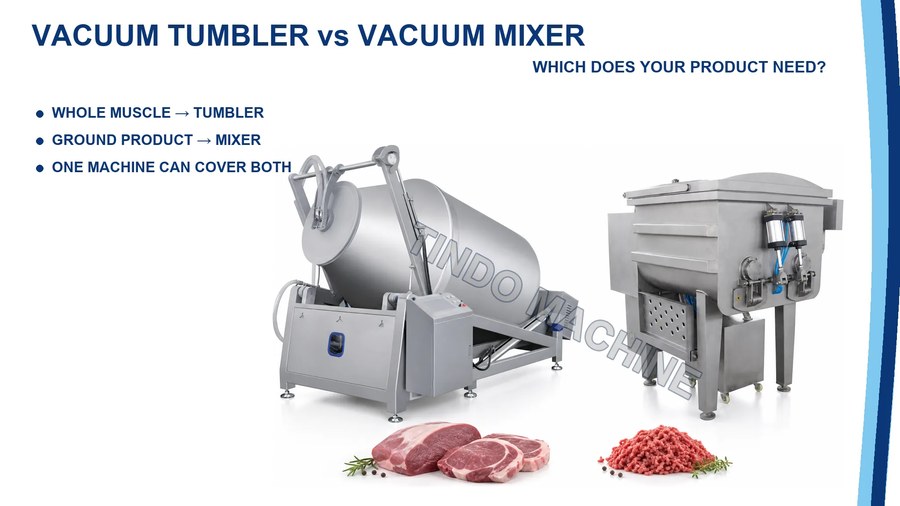
A vacuum tumbler and a vacuum mixer are often sold as if they were two answers to the same question. They are not. Both work under vacuum, and both are used on meat that is about to be marinated, cured or further processed — but they act on different products in different ways, and choosing the wrong one shows up later as broken muscle, smeared fat, or a marinated cut that is still dry in the centre.
The decision comes down to one thing: is your raw material a whole muscle or a ground mass?
Working principle | Drum rotates and lifts the meat mass, which falls back on itself | Dual Z-arms fold and blend the product in a stationary bowl |
Effective on | Whole-muscle cuts, bone-in pieces, coarse whole pieces | Ground and comminuted meat, emulsions, coarse-ground sausage |
What it achieves | Marinade penetration, binding, elasticity, colour retention | Uniform distribution of fat, water, additives and cure |
Typical products | Ham, bacon, wings, ribs, jerky, biltong, marinated steak | Frankfurter emulsion, bologna, meatballs, restructured ham, burger mix |
Speed range | 2–10 r/min (model-dependent) | 50–63 r/min |
Batch capacity | 100–3,000 kg | 120–900 kg |
Vacuum level | −0.06 to −0.08 MPa (spec table) | 0 to −0.085 MPa |
A tumbler is a vacuum drum with internal paddles. As the drum turns, the meat is carried up the wall and dropped back onto the mass below. Nothing cuts or shears the product — the only force is the product's own weight and the paddles redirecting it.
That is exactly why it works on whole muscle. Under vacuum the air is pulled out of the meat structure, the fibres open, and the brine or marinade is driven in by the repeated impact. The muscle stays intact, which is what you want for a ham that has to slice cleanly or a chicken wing that has to keep its shape through cooking.
Two practical points from the GR series specification:
Paddle geometry decides quality. The arc-shaped paddles are shaped to distribute marinade without damaging the meat surface. A tumbler with the wrong paddle profile either fails to move the product properly or starts to bruise it.
Speed is a process parameter, not a power setting. The range runs from 2 to 10 r/min depending on model. Long, slow cycles are for delicate whole cuts; shorter, faster cycles are for smaller pieces such as wings or diced product.
A vacuum mixer does the opposite job. The bowl stays still while twin Z-arms rotate through the product at 50–63 r/min, folding the mass over on itself. This is mechanical work applied to the product, not impact.
The reason a mixer needs vacuum is chemical rather than mechanical. Entrapped air in a mixing chamber acts as a microscopic oxidation site: oxygen reacts with the meat pigments, and air pockets stop the salt-soluble proteins from forming a continuous matrix around the particles. Pull the air out and both problems disappear — the extracted proteins (mainly myosin and actin) can form an uninterrupted gel network during cooking, which is what gives a product its dense, springy bite and its ability to hold water.
Three outcomes TINDO documents for the ZKJB series:
Cook yield up by 5–12% against atmospheric mixing, because the dense protein matrix binds water more effectively than a porous one.
Refrigerated shelf-life up 3–5 days, because oxygen-sensitive lipids and pigments stay stable without air in the chamber.
Marinade penetration 3–5× faster when the unit is used as a marinating mixer, since reduced pressure expands the muscle fibres and opens microscopic channels.
A word on vacuum level, because it is a commonly misread specification. The relationship is not linear: partial vacuum around −0.04 MPa captures only part of the available benefit, extraction efficiency climbs steeply between −0.06 and −0.08 MPa, and past roughly −0.085 MPa the gains flatten while pump energy and cycle time both rise. The ZKJB's factory setpoint sits at the top of that useful band.
Put the two side by side and the selection rule is short:
Choose a tumbler when the product must stay whole. Ham, bacon, bone-in poultry, ribs, jerky and biltong, marinated steaks, and any cut where a customer will judge the muscle structure by eye. A mixer would destroy exactly the property you are trying to create.
Choose a mixer when the product is ground or emulsified. Sausage batter, frankfurter emulsion, meatballs, burger mixes, nugget and patty blends, restructured ham. Here you need every particle coated with protein exudate and every gram of fat, water and additive distributed evenly — impact tumbling cannot do that.
Choose both when you make both. This is the common case in a plant running, say, marinated wings on one line and emulsified sausage on another.
There is one genuine overlap worth knowing about, because it affects how you buy.
A vacuum mixer running a slow cycle with vacuum applied can act as a marinating mixer on coarse and small-piece products — diced meat, wings, seasoned strips — and TINDO specifies the ZKJB series for exactly that dual role. For a mid-scale processor making both marinated poultry and sausage, one mixer can cover both jobs instead of buying a tumbler plus a mixer.
What a mixer cannot replace is the whole-muscle case. If your product is a formed ham, a bacon slab or a bone-in piece where the end user sees the muscle, that is tumbler work.
At the other end, a tumbler with the right paddles handles coarse-ground and small-piece products well, but it is not a substitute for the mixing action a Z-arm provides on a fine emulsion.
The two families overlap in batch size across most of their ranges, which makes the practical comparison straightforward. Sizes below are from the current TINDO specification tables.
Batch capacity | Vacuum tumbler (GR) | Vacuum mixer (ZKJB) |
|---|---|---|
~100–120 kg | GR-400 (≈400 L, 1.85 kW) | ZKJB-150 (150 L, 2.95 kW) |
~280–300 kg | GR-800 (≈800 L, 2.25 kW) | ZKJB-300 (300 L, 5.15 kW) |
~420–600 kg | GR-1500 (≈1,500 L, 6.85 kW) | ZKJB-600 (600 L, 7.85 kW) |
~900–1,000 kg | GR-2800 (≈2,800 L, 9.35 kW) | ZKJB-1200 (1,200 L, 12.85 kW) |
~3,000 kg | GR-6000 (≈6,000 L, 15 kW) | — |
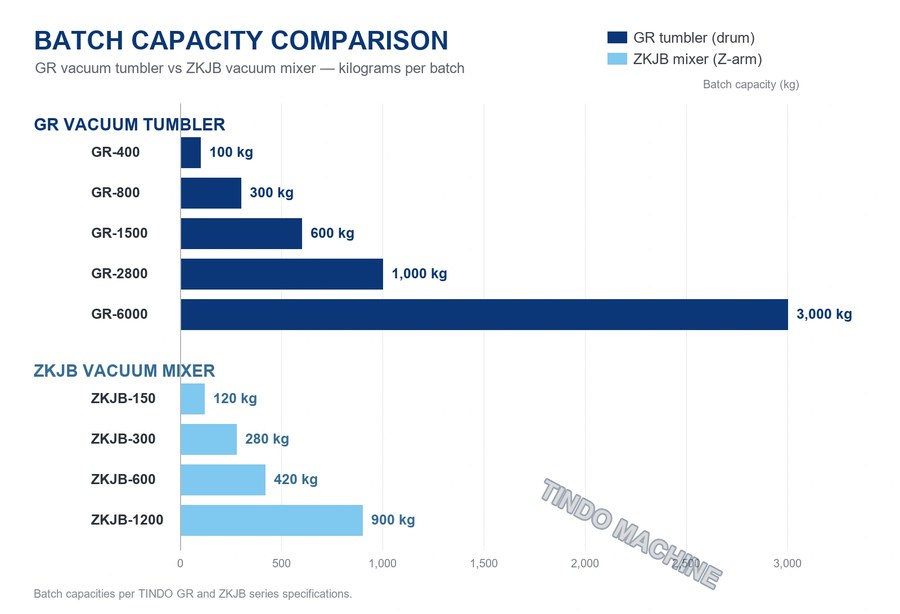
Two observations from that table. First, the drum volumes are much larger than the mixing bowl volumes for a comparable batch weight — a tumbler needs free fall space, so its drum is big relative to the load. Second, the mixer carries the larger motor for the same batch weight, because it is doing continuous mechanical work rather than letting gravity do it.
Vacuum level, measured at the chamber. A tumbler in the −0.06 to −0.08 MPa band and a mixer at −0.085 MPa are both doing real work, but the number should match the product. Verify which value is on the machine's own specification sheet, not just the marketing line.
Drive duty. Mixing is continuous mechanical load; a geared drive rated for industrial cycles matters more here than on a tumbler, where the load is periodic.
Lid and cleaning access. A hydraulic-assist lid that opens fully, tool-free paddle or arm removal, and a fully welded, mirror-polished interior decide how long your sanitation shift takes.
Temperature control. Standard tumblers cool passively, relying on pre-chilled meat and ice. If you run long cycles on thick cuts or bone-in poultry, friction heat will push the load past 4 °C and dilute your brine. TINDO offers a refrigerated tumbler variant with an external chiller holding 0–4 °C through the cycle, with per-batch temperature logging.
Electrical configuration. Both series are built to the destination supply, so name your voltage and frequency at enquiry stage.
Can one machine really do both jobs?
A vacuum mixer with slow-speed cycles handles a good part of marinating work on small and coarse pieces, and TINDO specifies the ZKJB series for that dual role. It does not replace a tumbler for whole-muscle products where the muscle structure has to stay intact.
Which one for cooked ham?
A tumbler, unless the ham is restructured from smaller pieces. Whole-muscle and bone-in product needs the impact action; restructured and sectioned product benefits from the binding a mixer develops.
Which one for frankfurters and bologna?
A mixer. These are emulsions: the vacuum step is what stops air pockets forming a porous, spongy structure that purges during cooking.
Does a higher vacuum always mean better product?
No. Extraction efficiency climbs steeply to roughly −0.08 MPa and then flattens, while pump energy and cycle time keep rising. Running far past the product's requirement extends the cycle without improving the result.
Can either machine handle frozen meat blocks?
Neither is designed for deep-frozen input. Both work on fresh or tempered meat around −2 °C to +4 °C; frozen blocks should be pre-ground first. Semi-frozen meat tempered to about −3 °C to −1 °C performs well and can even improve particle definition in coarse-ground product.
Do I need both if I make marinated wings and fresh sausage?
Usually not at the start. A vacuum mixer covers the marinated small-piece work and the emulsion work. Add a tumbler when whole-muscle volume justifies a dedicated machine and a dedicated cycle.
Write down two things before you look at models: the form of your raw material (whole muscle or ground), and the finished texture your customer will judge (intact muscle or uniform bind). Those two answers select the machine family. Batch weight and plant layout then select the size within it.
Vacuum tumbler and marinating range | Vacuum mixer ZKJB series | Meat mixing machinery
Send us your product form, batch weight and cycle time and our engineers will tell you which family fits — the vacuum tumbler or the vacuum mixer — including the cases where one mixer covers both jobs. Ask our application engineers.


