
English 
Zhengfeng Road, Licheng District, Jinan City, Shandong Province,China
Author: Alex Song Publish Time: 2026-10-11 Origin: Site
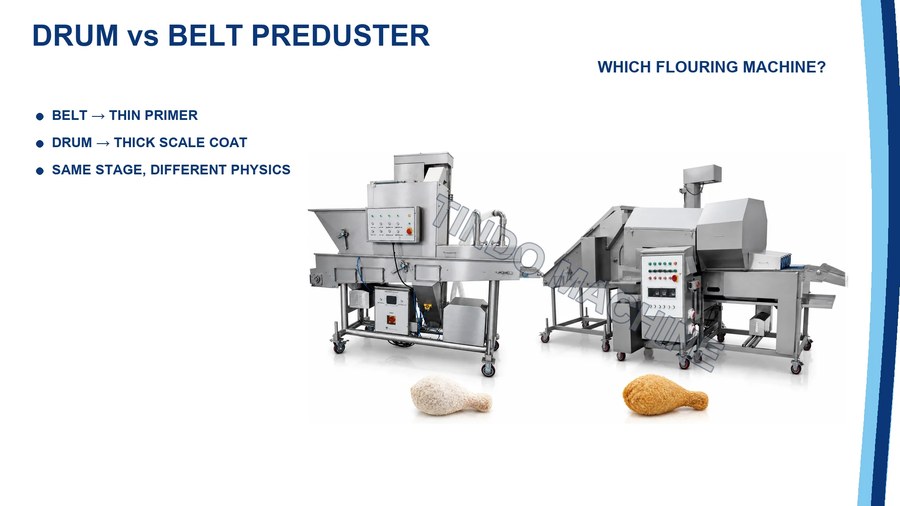
Most coating problems that get blamed on the batter or the breading start one station earlier. The preduster decides how well everything after it sticks, and the first specification question is not which machine but which family: a belt preduster or a drum preduster. They both apply dry flour, and after that they have almost nothing in common.
A preduster applies a dry flour layer before the wet batter. Without it, batter beads up on a raw, moist surface — the protein film slides instead of anchoring, and the result is bare patches that show up as pale, uneven colour after frying.
So far both families agree. Where they separate is what the flour is for:
On a belt preduster, the flour is a primer — thin, even, and largely invisible in the finished product. Its only job is to give the batter a dry surface to grip.
On a drum preduster, the flour is the coating. Product tumbles inside a rotating drum, picks up a heavy, scale-like layer, and that texture is what the customer sees and judges.
That single distinction decides most of the specification.
The FLU series preduster is a single-pass belt machine. Flour is delivered as a curtain drop with air-assisted circulation, so the underside of the product receives the same coat as the top — the detail that removes bare patches downstream. Excess flour is collected under the belt and recirculated through a vibrating screen that separates crumbs from reusable flour.
FLU400 | FLU600 | |
|---|---|---|
Belt width | 400 mm | 600 mm |
Belt speed | 3–15 m/min (VFD) | 3–15 m/min (VFD) |
Infeed / discharge height | 1,050 / 850 mm | 1,050 / 850 mm |
Power | 2.17 kW | 3.7 kW |
Flour system | Circulation + recycling screen | Circulation + recycling screen |
Material | Full SUS304 | Full SUS304 |
Typical throughput | up to ~300 kg/h | up to ~600 kg/h |
Two features matter more than they look. Variable belt speed from 3 to 15 m/min is how the preduster is synchronised with the former upstream and the batter applicator downstream — a speed mismatch of a couple of percent shows up as product pile-up at the transfers. And the recycling screen matters on fine flours: without it, crumbs build up in the flour bed and end up on the product.
The drum family splits again into one pass or two.
A single-drum machine tumbles product through one flour drum — a heavier coat than a belt can produce, at roughly 100–300 kg/h. It suits whole-muscle pieces and irregular shapes where a belt curtain cannot reach every surface.
A double-drum machine, like the FLU-DS series, passes the product through two drums in series, doubling flour-to-product contact time. That is what produces the thick, flaky, scale-like coating behind products such as salt crispy chicken, pot-wrapped meat and small crispy pork.
Single drum (FLUG-600) | Double drum (FLU-DS series) | |
|---|---|---|
Coating passes | 1 | 2 sequential |
Best for | Thin to medium flour layer | Thick, scale-like layer |
Flour adhesion | Good on flat, uniform products | Excellent on irregular, whole-muscle products |
Thickness adjustment | Belt speed only | Belt speed + independent flour feed rate |
Typical throughput | 100–300 kg/h | 200–500 kg/h |
Cleaning | Single-body washdown | Modular separation, washdown per section |
Two FLU-DS details are worth pointing at. First, independent variable-frequency flour dosing: coating thickness is dialled in during production without stopping the line, which is what lets one machine run chicken rice in the morning and salt crispy chicken in the afternoon. Second, waterproof modular construction: infeed, drum one, drum two and discharge are separate sealed modules joined by quick-release clamps, so each section can be pressure-washed on its own — the failure mode this design avoids is washdown water reaching bearings and motors on single-body machines.
Belt preduster (FLU400 / FLU600) | Single drum (FLUG-600) | Double drum (FLU-DS600 / DS800) | |
|---|---|---|---|
Belt width | 400 / 600 mm | 600 mm | 600 / 800 mm |
Speed range | 3–15 m/min | 3–15 m/min | 3–18 m/min |
Drum | none | 1 × Ø400 mm | 2 × Ø400 mm / 2 × Ø450 mm |
Installed power | 2.17 / 3.7 kW | 8.6KW | 13 / 14.45 kW |
Infeed / discharge height | 1,050 / 850 mm | 1,000 / 950mm | 1,000±50 / 950±50 mm |
Coating role | Primer before batter | Medium flour layer | The coating itself |
Thickness control | Belt speed | Belt speed | Belt speed + flour feed rate |
This is the table that settles the argument in practice. Belt speeds below are the settings TINDO publishes for the FLU series; drum settings are the dosing profiles published for the FLU-DS.
Product | Coating wanted | Machine family |
|---|---|---|
Chicken nuggets, tenders | Thin wheat-flour primer | Belt (8–12 m/min) |
Fish fillets | Light primer, delicate handling | Belt (10–15 m/min) |
Shrimp | Gentle primer, no breakage | Belt (10–12 m/min) |
Onion rings | Firmer primer for batter grip | Belt (8–10 m/min) |
Vegetable fritters | Primer for sticky batter | Belt (6–10 m/min) |
Plant-based nuggets | Consistent primer on soft dough | Belt (8–12 m/min) |
Salt crispy chicken | Heavy, flaky scale coat | Double drum (10–12 m/min) |
Pot-wrapped meat | Thick, even flour layer | Double drum (12–15 m/min) |
Small crispy pork | Dense, clingy flour | Double drum (8–10 m/min) |
Chicken wings / drumsticks | Clinging to rugged coat | Double drum (8–12 m/min) |
Squid rings | Medium cling coat | Double drum (12–15 m/min) |
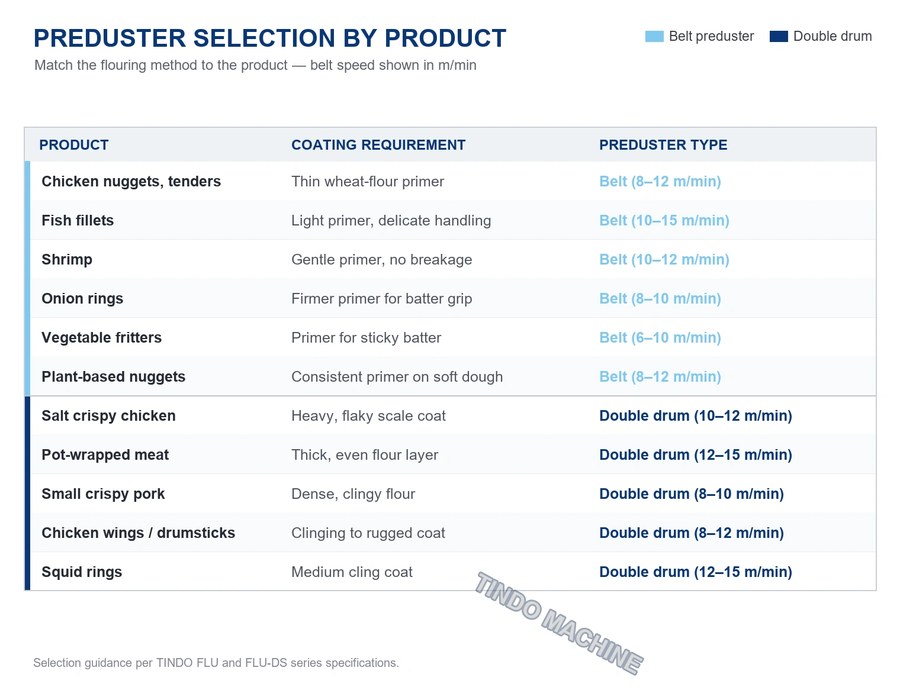
The pattern is consistent: flat, uniform, batter-bound products go on a belt; irregular or whole-muscle products whose finished texture is the flour itself go through drums.
On a belt preduster, thickness is controlled indirectly — by belt speed, which changes how long the product sits under the flour curtain. It is enough when the flour is a primer that will be covered by batter and crumb.
On a drum preduster, thickness is a direct setting. The FLU-DS controls flour feed rate on a variable frequency drive independently of belt speed, so an operator can move from a light dusting to a heavy scale coat without stopping production or changing hardware. If your product range spans both light and heavy flour coatings, that single control is usually the deciding feature.
A belt preduster is the quicker machine to clean: the flour hopper and belt release on quick-release clamps, and a full changeover between products — chicken to fish, for example — runs under ten minutes including washdown.
A drum machine takes longer because there is more of it, but the modular design changes the arithmetic: each sealed section washes down independently, and full cleaning runs around fifteen to twenty minutes. The trade is that a drum machine is a physically larger unit — the FLU-DS600 sits at 5,300 × 2,800 × 2,300 mm — so it needs planning space at the line layout stage, not at installation.
Speeds are the constraint that matters. Belt predusters run 3–15 m/min and double-drum units 3–18 m/min; whichever you choose has to be matched to the former, the batter applicator, the breader and the fryer. Coating dwell times only stay stable if the belts move at the same rate from one end of the line to the other.
Heights matter too. The FLU series discharges at 850 mm and the FLU-DS at 950±50 mm — details that decide whether a transfer conveyor is a short bridge or a redesign. On drum lines loading from a tumbler, TINDO also offers an optional bucket or inclined elevator that lifts marinated product straight to the preduster infeed, removing one manual transfer and one operator per shift.
Which preduster for fried chicken?
A drum machine — and specifically a double-drum, because fried chicken and salt crispy chicken are judged on the thickness and flakiness of the flour layer. A belt preduster cannot build that coat in a single pass.
Which preduster for nuggets and patties?
A belt preduster. These products take a thin, even primer that the batter then grips, and the belt's curtain-and-air system coats flat surfaces consistently at 8–12 m/min.
Can one machine cover both product types?
Only partly. A double-drum unit with variable flour dosing covers light dusting through heavy scale coat, which is why it is specified for plants running several Asian crispy products on one shift. It does not replace a belt machine for high-volume nugget and fish production, where a belt unit runs faster, with a cleaner flour bed and simpler upkeep.
Does a belt preduster work with any flour?
Wheat, corn, rice and blended coating mixes all run through the circulation system without clogging. The vibrating screen matters here — it keeps crumbs out of the reusable flour bed.
How long does product changeover take?
Under ten minutes on a belt preduster including washdown; roughly fifteen to twenty minutes on a drum machine, where each sealed module is washed separately.
What about electrical configuration?
The FLU series is supplied at 380 V/50 Hz as standard, with 415 V/50 Hz and 480 V/60 Hz available by custom order — worth naming at enquiry stage rather than at installation.
If the flour is a primer that will disappear under batter and crumb, specify a belt preduster. If the flour is what your customer sees and tastes — the scale coat on fried chicken, the dense layer on crispy pork — specify a drum preduster, and use two drums when the coat has to be heavy and flaky.
FLU belt preduster series | Double-drum preduster FLU-DS | Single-drum flouring machine | Coating machine range
Tell us what you are coating and at what throughput, and our engineers will confirm the family, the belt width and the drum configuration — including the batter and breading stages that follow it. Request a specification review.


