
English 
Zhengfeng Road, Licheng District, Jinan City, Shandong Province,China
Author: Site Editor Publish Time: 2026-11-23 Origin: Site
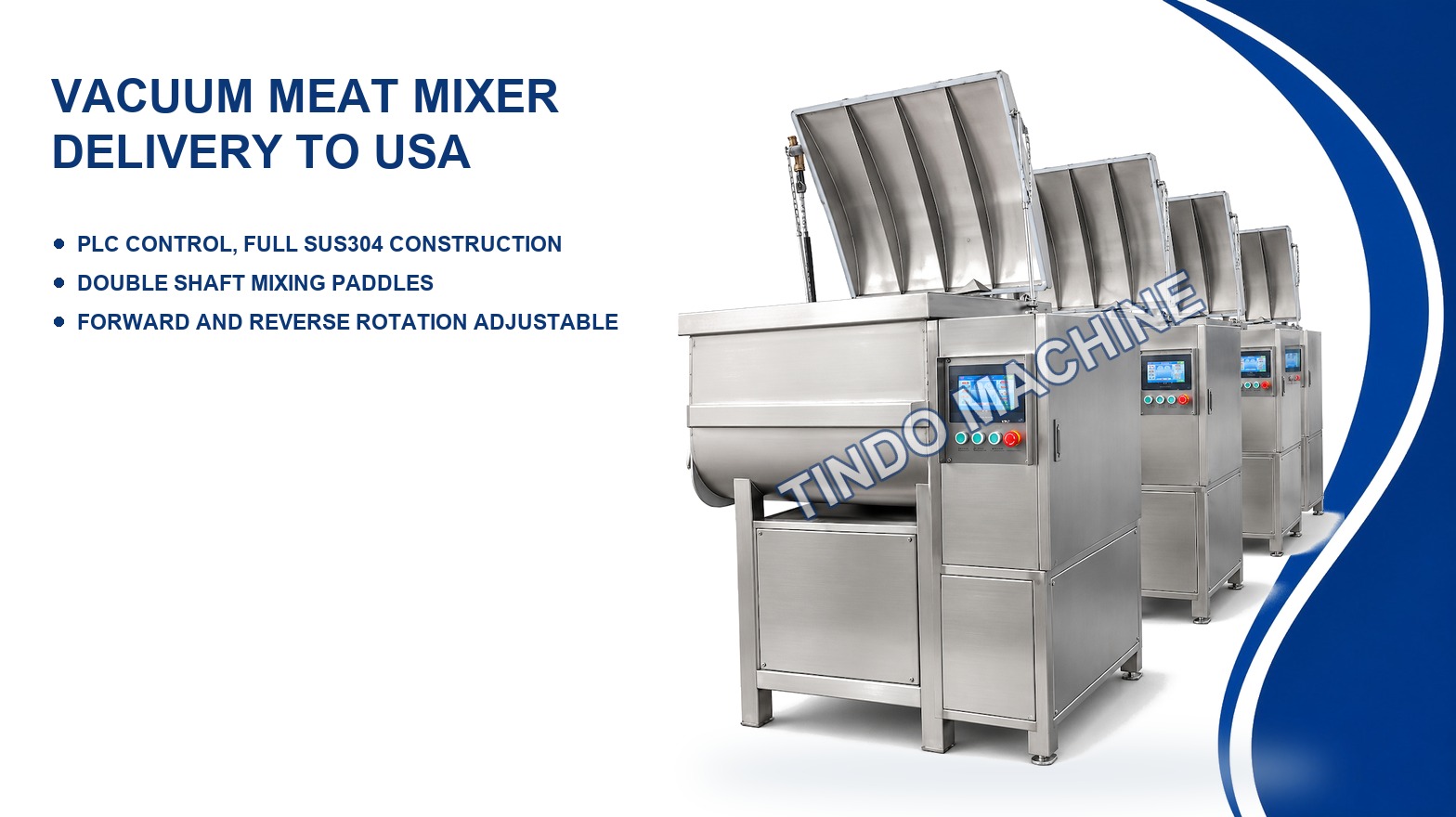
Four ZJB350 vacuum meat mixers have finished factory testing and are standing crated on our floor, waiting for the container that takes them to a processor in the United States. They are identical units built to one specification, which changes what the testing has to prove.
A single machine can be tuned on site until it behaves. Four cannot, because the moment one drifts out of step with the others the plant is running two recipes on four lines. So the build is standardised: same drawings, same fixtures, same component list, and every unit tested against the same set of checks rather than to whatever each one happens to do.
The practical consequences show up months later. Paddles, seals and shaft bearings are interchangeable between units, so one spare kit covers all four. An operator trained on one machine can run any of them. And if a unit goes down mid-shift, product can move to another line while the fault is dealt with, which is the reason plants order in batches in the first place.
A vacuum mixer is not signed off on looks. The checks that decide whether a unit ships fall into three groups.
Dry run. Shafts turn in both directions at the set speeds, the lid closes and seals, the vacuum pump pulls the chamber down and the reading holds with the pump off. A chamber that leaks down slowly will still mix, but it will not de-aerate, and that fault is invisible until the first batch comes out pale and crumbly.
Loaded run. The chamber is charged and mixed under vacuum. This is where dead zones show up — material that sits in a corner of the trough and never reaches the paddles — and where the discharge is proven to empty the trough rather than leave a heel behind.
Control sequence. The PLC has to refuse the wrong order of operations: no mixing with the lid unlatched, no vacuum with the discharge open, and an emergency stop that actually stops both shafts and the pump rather than one of them.
PLC control. Recipe settings live in the controller rather than in an operator's memory: shaft speed, direction pattern, mixing time, vacuum level. A recipe is recalled instead of dialled in, which is what makes the four units behave alike even when four different people are running them.
Full SUS304 construction. Every surface the product touches and most of what it does not is stainless. In a room that gets washed down with chlorinated water and handles brine, painted steel and mild-steel fasteners are where corrosion starts, and a flaking coating is a foreign-body risk.
Double shaft mixing paddles. Two shafts turn against each other so the mass is folded and sheared rather than pushed around the trough in a single direction. That matters with stiff, high-fat or high-binder mixes, where one shaft tends to carve a channel and let the rest of the batch sit still.
Forward and reverse rotation adjustable. Reversing is not only a discharge aid. It lets the operator change the folding pattern for a different product without changing the machine, and it clears material that has climbed the end plates before it sets.
Four units arriving at once is a handling problem before it is a production one. Each needs a floor that takes its loaded weight, and a route from the door that clears the frame. The lids open upward and stand well above the machine when raised, so ceiling height and any pipework overhead has to be checked against the open position, not the closed one.
On utilities, the vacuum pump and the controls need their supply confirmed at the plant voltage before the units are set in place — moving a machine after the services are run is the part of a project that always eats a day. Rigging equipment sized for one unit is worth checking against four, particularly if they are going onto a mezzanine.
Upstream is a grinder or bowl cutter and the weighing station that sets the recipe; downstream is the forming machine, the filler or a tumble and marinate stage. The vacuum stage belongs between the two, because mixing under vacuum is what keeps the lean and fat bound together and the colour from turning before the product is formed.
The vacuum meat mixer machine page covers the model range and the control options, and the meat mixing machinery category covers the atmospheric mixers and tumblers that sit either side of it. If you are still deciding between the two approaches, vacuum tumbler versus vacuum mixer sets out where each one earns its place on the line.
