
English 
Zhengfeng Road, Licheng District, Jinan City, Shandong Province,China
Author: Alex Song Publish Time: 2026-10-08 Origin: Site
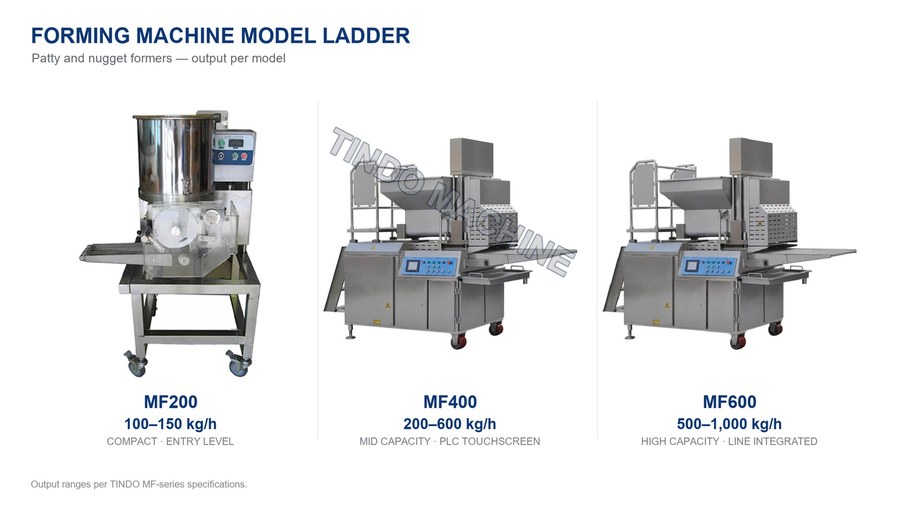
Choosing between the MF200, MF400 and MF600 looks like a straightforward capacity decision. It is not. All three machines hold the same ±2 g weight accuracy, all three change moulds in under five minutes, and all three are built from SUS304 with CE certification. The difference between them is not quality. It is what each machine is designed to do all day.
This guide compares the three models on the numbers that change your operation — capacity, piece weight, mould range, footprint and changeover — and explains the one trade-off most buyers miss.
MF200 | MF400 | MF600 | |
|---|---|---|---|
Capacity | 100–150 kg/h | 200–600 kg/h | 500–1,000 kg/h |
Piece weight range | 20–200 g | 15–200 g | 20–250 g |
Weight accuracy | ±2 g | ±2 g | ±2 g |
Mould change | Under 5 min | Under 5 min, toolless | Under 5 min, hydraulic auto-lock |
Mould types | Round, square, nugget, custom | Round, square, nugget, strip, meatball, custom | Round, square, nugget, strip, meatball, custom |
Footprint | Under 2 m² | Under 3 m² | Under 5 m² |
Construction | Full SUS304 | Full SUS304 | Full SUS304, reinforced frame |
Certification | CE | CE | CE |
Two things stand out immediately. First, accuracy is identical across the range — you do not buy better portion control by spending more. Second, the footprint grows far more slowly than the capacity does: a machine that produces roughly seven times the MF200's output occupies under three times the floor area.
The MF200 compact patty and nugget former is built for startups, small processors, and established plants testing a new product line before committing floor space to it. It produces 100–150 kg/h, forming 600–1,500 pieces per hour with a single operator, and it fits into under 2 m².
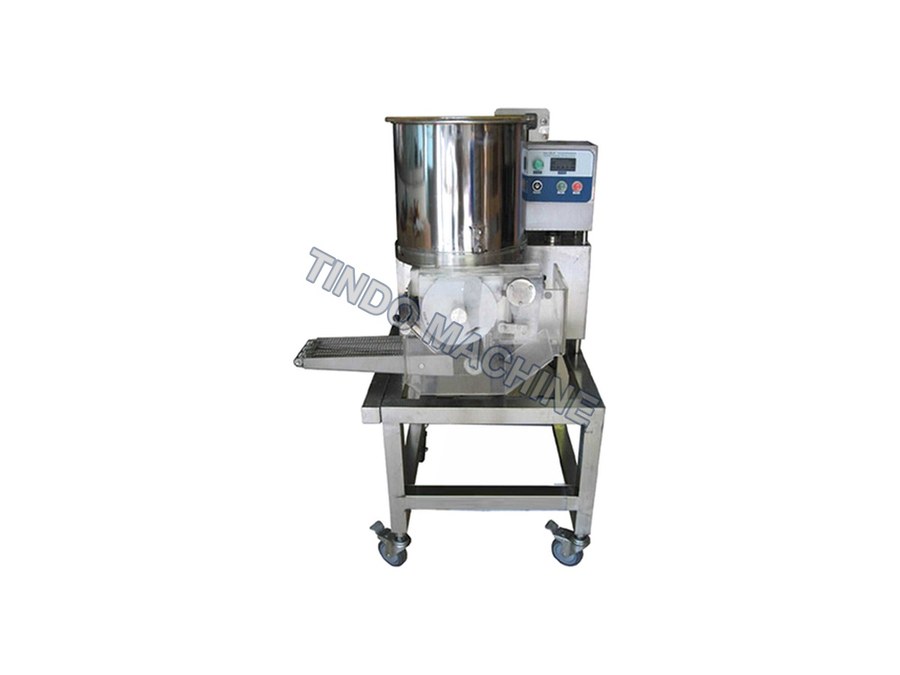
Compared with forming by hand, the numbers are worth stating plainly. Manual forming with three or four workers yields roughly 300–500 pieces per hour at ±15 g. The MF200 produces 600–1,500 pieces per hour with one operator at ±2 g. Portion accuracy improves by an order of magnitude, and the labour requirement drops to a single person.
The MF200 runs the same mould standard as the larger models, which means mould sets, training and maintenance procedures carry forward if you later add an MF400 or MF600. That is the practical reason it works as an entry point rather than a dead end.
Choose it when: you are launching a formed-product line, your target is under 150 kg/h, or you need to validate a product before investing in higher-capacity equipment.
The MF400 mid-capacity patty and nugget former is the machine in the series designed for processors who run more than one protein. It covers 200–600 kg/h, with the actual figure depending on the protein and product being formed, and it accepts round, square, nugget, strip and meatball moulds as standard.
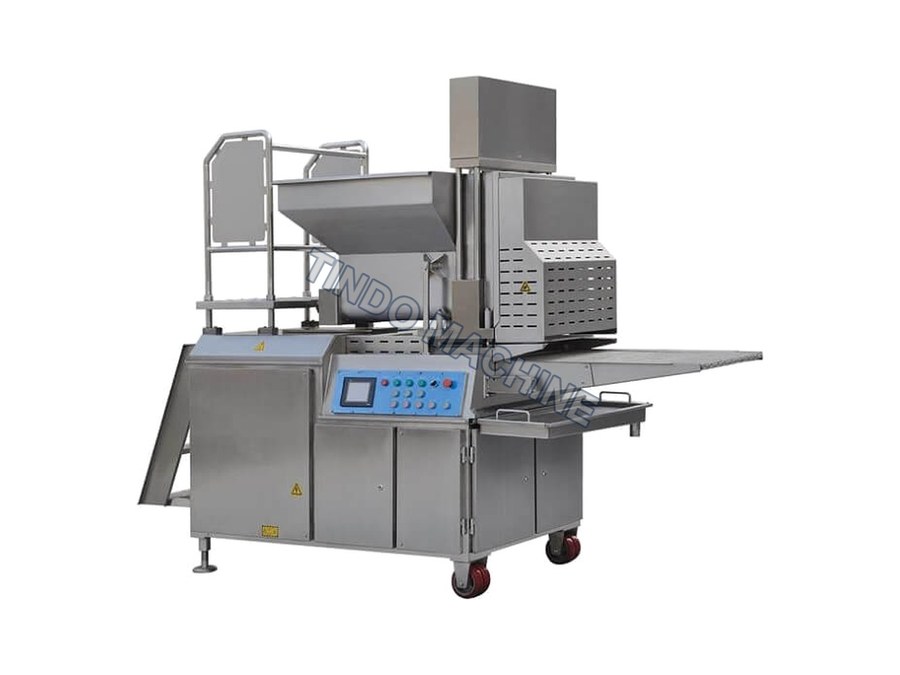
Where the MF400 differs from the MF200 is not just capacity. It runs a PLC touchscreen with preloaded protein profiles, so switching between chicken, beef, pork, fish and plant-based blends means selecting a profile rather than re-tuning the machine. The hopper holds 150 L, with a temperature-maintaining jacketed option, and mould changes are toolless.
The case for a single versatile machine over several dedicated ones is usually argued on floor space and labour. The comparison holds up on those grounds alone: one MF400 needs under 3 m² against roughly 7.5 m² for three specialist stations, and one operator against three. It also consolidates maintenance to a single hydraulic system and a single set of wear parts instead of three.
Choose it when: you produce several proteins or product shapes, your output sits between 200 and 600 kg/h, or you run co-packing and R&D work where the product mix changes weekly.
The MF600 high-capacity industrial forming machine is the top of the series, running 500–1,000 kg/h. TINDO's throughput data puts this in concrete terms: at 113 g per quarter-pound patty it produces 60–88 pieces per minute, or 400–600 kg/h. On 200 g steak-cut patties it produces 40–50 pieces per minute at 480–600 kg/h. At full rate the machine is rated for over 8,800 quarter-pound patties per hour.
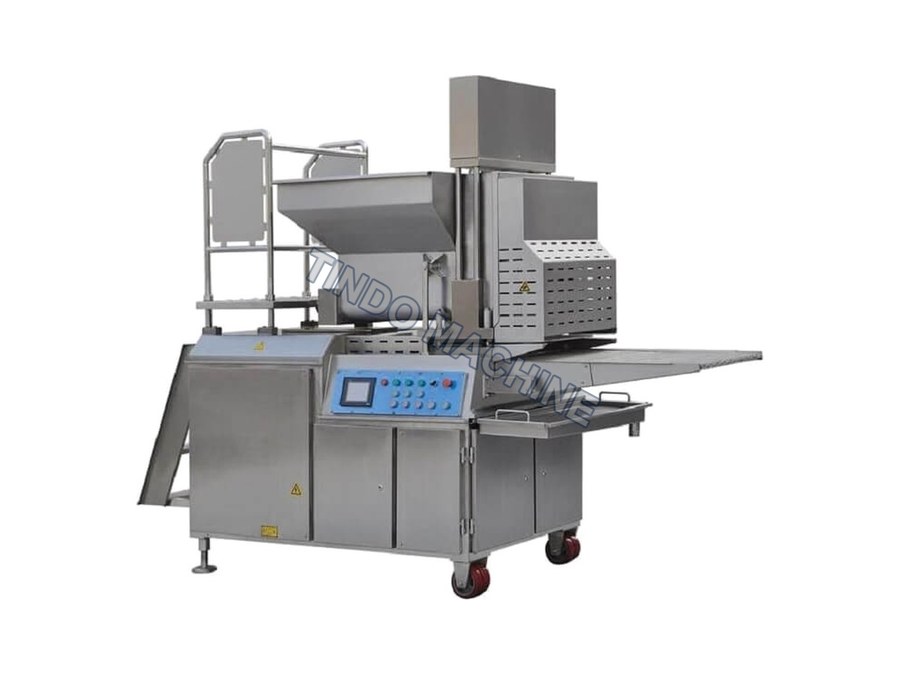
What justifies the MF600 is not only throughput but how it holds up under continuous running. Its hydraulic cylinder is rated for 2 million-plus cycles between service intervals — roughly three times the service life of a standard MF400 cylinder — with a hardened filling chamber and a hydraulic auto-lock mould clamping system that verifies pressure before each stroke. The hopper holds 200 L as standard, with a 350 L extended option to reduce refill frequency on long runs. Mould changes are hydraulic and automated.
The MF600 also carries condition monitoring: hydraulic pressure consistency, motor winding temperature, cycle count, weight variance trend across the last 500 cycles, and energy consumption per 1,000 pieces. That is what makes planned maintenance possible instead of reactive repair, which matters most in plants where an unplanned stop can idle a whole shift.
Choose it when: you run one or two products at very high volume, you measure output in tons per shift, or you need maximum production per square metre of floor.
Reading the specifications side by side, four things change and two do not.
What stays the same: weight accuracy (±2 g throughout) and the basic forming principle. Every model forms by filling a mould and ejecting the shaped piece, so product appearance and texture do not change with the model — only the rate at which you make it. Whether a former uses a drum or a belt is a separate structural question, covered in our drum vs belt forming machine comparison.
What changes:
1. Throughput per hour — from 100–150 kg/h to 500–1,000 kg/h. 2. Piece weight ceiling — the MF200 and MF400 top out at 200 g; the MF600 reaches 250 g, which is what lets it form large steak-cut patties. 3. Mould inventory — the MF200 offers round, square, nugget and custom moulds; the MF400 and MF600 add strip and meatball. 4. Duty rating and service intervals — the MF600's reinforced hydraulic core and condition monitoring are designed for 24/7 operation; the smaller models assume normal production shifts.
This is the decision that catches buyers out, because the answer is not simply "the big one is better".
Run the numbers honestly. Four MF400 units in parallel have a theoretical combined output of 800–2,400 kg/h, which is higher than a single MF600 at 500–1,000 kg/h. If raw tonnage were the only criterion, four mid-size machines would win.
The MF600's advantage lies elsewhere: density, labour and maintenance consolidation. Those four MF400s occupy roughly 12 m² against under 5 m² for one MF600. They need four operators against one. They present four hydraulic systems and four sets of wear parts to maintain instead of one heavy-duty system rated for three times the service life. And they run four separate controllers rather than one centralised unit.
The trade-off in the other direction is flexibility. Four MF400s can run four different products simultaneously; the MF600 runs one product at maximum rate. So the rule is:
Multiple SKUs running at once → several smaller machines. If your production plan has four products on the schedule at the same time, a single large former cannot serve them.
One or two products at high volume → one MF600. If your line makes the same two products day after day, consolidating to a single machine on under 5 m² is the better structure.
The same logic works one step down: an MF400 replacing three specialist forming stations trades simultaneous flexibility for half the footprint, a third of the operators and one hydraulic system instead of three. If your production is a single shape at high volume instead of a mixed portfolio, the MF300 dual-patty forming machine occupies the same 200–600 kg/h band but forms two patties per stroke.
The most common sizing mistake is to divide daily output by shift hours and buy the model whose capacity figure sits just above the result. That ignores piece weight, which drives the real rate.
Piece weight determines how fast any former can run, because each stroke forms a fixed number of mould cavities. At 25 g per nugget, the MF600 produces 120–180 kg/h. At 113 g per quarter-pound patty, the same machine produces 400–600 kg/h. At 200 g per steak-cut patty it reaches 480–600 kg/h. Same machine, same settings philosophy, a four-fold difference in output — driven entirely by piece weight.
So work from your product mix:
1. List each product and its piece weight. 2. Find the heaviest and lightest piece you will run. 3. Take the lowest kg/h the machine achieves on any of those products — that is your realistic capacity, not the headline figure. 4. Check that the lightest product still falls above the minimum piece weight for the model, and the heaviest below the maximum.
A plant producing 25 g nuggets needs a machine roughly four times larger on paper to match the throughput of a plant producing 113 g patties — for the same kg/h target.
All three models change moulds in under five minutes, but the mechanism differs: the MF200 and MF400 are toolless quick-change, while the MF600 uses hydraulic auto-lock with pressure verification. The MF400 adds protein profiles on a PLC touchscreen, so switching between chicken, beef and plant-based blends is a profile selection rather than a mechanical re-tune.
For plants running several SKUs per shift, that combination — sub-five-minute mould change plus stored profiles — is what determines whether a former can realistically serve multiple products in one day. It is also why a versatile mid-range machine often beats a higher-capacity single-purpose one in mixed production.
1. What is your lowest-throughput product? Size on that, not on your best case. 2. What is your heaviest piece? Above 200 g, the MF200 and MF400 are out of range — the MF600 reaches 250 g. 3. Do you need strip or meatball shapes? Those moulds start at the MF400. 4. How many products run simultaneously? Several at once favours multiple smaller machines; one or two favours a single large one. 5. How hard will the machine run? Continuous 24/7 operation points to the MF600's duty rating and condition monitoring; single-shift operation does not require it. 6. How much floor space do you have? Under 2 m² for the MF200, under 3 m² for the MF400, under 5 m² for the MF600 — and compare that against the combined footprint of any alternative arrangement. 7. Will you add products later? Mould standards carry across the series, so starting smaller does not lock you out of the larger machines.
Is the MF600 more accurate than the MF200? No. All three models hold ±2 g weight accuracy. Accuracy is a design constant across the series, not a feature you upgrade into. The difference between the models is output, piece weight range and duty rating.
Can the MF200 be upgraded later, or do I start again? Mould sets, operator training and maintenance procedures carry forward across the series. Moving from an MF200 to an MF400 or MF600 does not strand your existing tooling.
Why does the MF600 produce less per hour on nuggets than on patties? Because nuggets are lighter. At 25 g the machine forms 120–180 kg/h; at 113 g per quarter-pound patty it forms 400–600 kg/h. The stroke rate is similar — the weight per piece is what changes.
Can one former serve several products in the same shift? Yes, if changeover is short enough. All three models change moulds in under five minutes, and the MF400 and MF600 store settings so a switch is a profile selection rather than a re-tune. For plants running four or more products simultaneously on separate lines, several smaller machines remain the more practical structure.
What happens upstream of the former? Forming machines are specified for chilled meat, typically −2 °C to +4 °C. If your raw material arrives as deep-frozen blocks, it needs pre-grinding before it reaches the hopper, and the former is best placed downstream of a grinder in that configuration.
If you take one point from this comparison: the three machines in the MF series are not a quality ladder, they are a duty ladder. Accuracy, construction and mould-change speed are held constant; what you are choosing is throughput, piece weight ceiling, mould range and how hard the machine can be run.
Size on your lightest product rather than your headline tonnage, decide whether you need simultaneous multi-product flexibility or consolidation onto one line, and let the answers point to the MF200, MF400 or MF600. TINDO's application engineers can map your product list and piece weights to the right former — the full forming machine range is the starting point — and confirm the upstream and downstream equipment the line will need.


