
English 
Zhengfeng Road, Licheng District, Jinan City, Shandong Province,China
Author: Alex Song Publish Time: 2026-10-18 Origin: Jinan TINDO International Co., Ltd
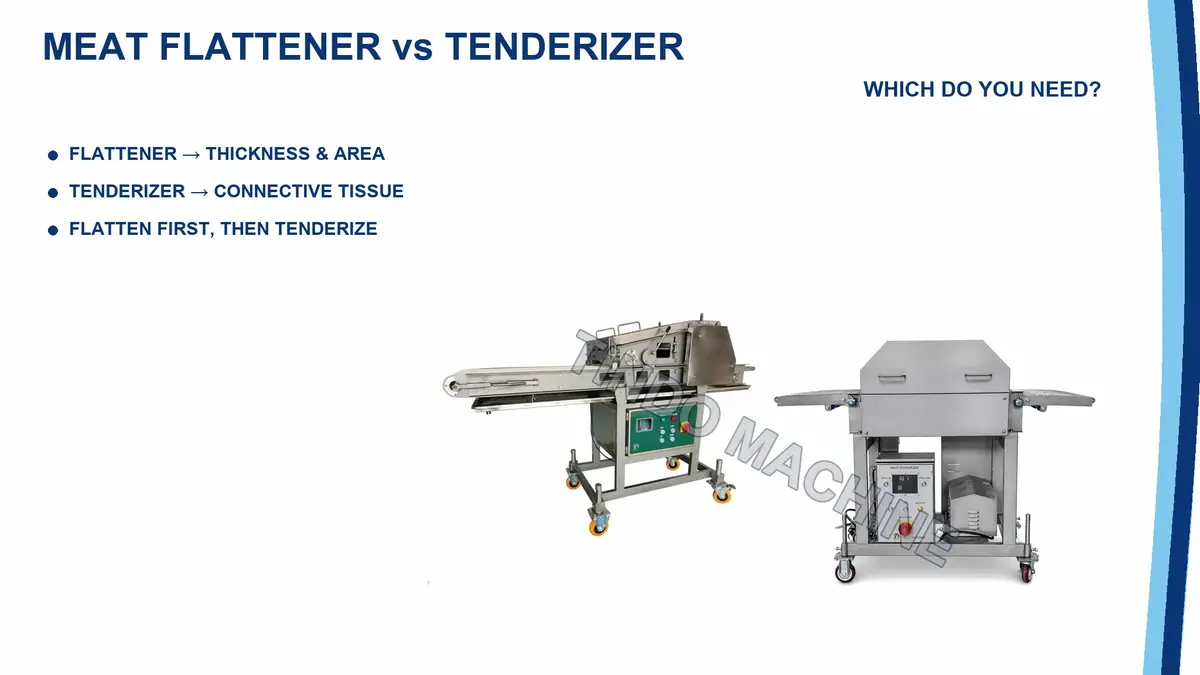
"Flattener" and "tenderizer" get used interchangeably on the production floor, and the two machines do sit next to each other in most lines. They are not alternatives. One changes the shape of the cut; the other changes the structure inside it. Buying the wrong one is a common and avoidable mistake, because the symptoms show up late — as inconsistent portion weight, or as marinade that sits on the surface instead of going in.
Flattening is a dimensional operation. Product passes between driven rollers set to a fixed gap. The cut comes out thinner and larger in surface area, and — this is the point — the same every time. On the YY400 and YY600 flattener the belt widths are 400 mm and 600 mm. The 8-roller version uses a calendering arrangement with adjustment down to 0.1 mm, which is what takes thickness variation out of a batch rather than simply squashing the product.
Nothing about the muscle structure is deliberately changed. A flattened breast is the same meat, thinner.
Tenderizing is a structural operation. Needle rollers drive small blades or needles through the surface of the cut, cutting connective tissue without tearing the muscle fibres apart. Our NH400 and NH600 tenderizers use micro-needle rollers with adjustable needle spacing from 5 mm to 30 mm and a roller blade diameter of 130 mm. The result is a cut that holds together but takes marinade much faster, because the surface is now full of channels into the muscle.
Nothing about the dimension is deliberately changed. A tenderized breast is the same thickness, more open.
This is the practical way to choose: start from the defect you are trying to remove.
| Symptom on your line | The machine that fixes it |
|---|---|
| Portions vary in thickness and weight | Flattener |
| Product springs back and will not hold a shape | Flattener (plus adequate chilling) |
| Marinade pools on the surface and drains off | Tenderizer |
| Cooked product is tough despite marinating | Tenderizer |
| Coating will not sit flat or adhere evenly | Flattener first — a level surface coats evenly |
| Breaded product curls or blisters in the fryer | Flattener, then tenderizer where marinade is involved |
The last two rows explain why these two machines so often appear together. A flattener gives the coating a uniform surface to sit on. A tenderizer gives the marinade a way in. Neither substitutes for the other.
| Flattener — YY series | Tenderizer — NH series | |
|---|---|---|
| Models | YY400, YY600 (8-roller version: YY400-II, YY600-II) | NH400, NH600 |
| Belt width | 400 mm / 600 mm | 400 mm / 600 mm |
| Throughput | 800–1,200 kg/h (8-roller version) | Up to 1,500 kg/h (NH400); up to 2,500 kg/h (NH600) |
| Working element | Driven rollers, calendering gap | Micro-needle roller, 130 mm blade diameter |
| Adjustment | Thickness, down to 0.1 mm on the 8-roller version | Needle spacing 5–30 mm |
| Belt speed | 4–19 m/min (mesh belt) | 3–15 m/min, inverter controlled |
| Motor | 1.5 kW class | 1.5 kW (NH400) / 2.2 kW (NH600) |
| Washdown | IP65, 304 stainless plate, 3 mm | 304 stainless food-contact parts |
| Input/output height | 1,030 ± 50 mm | — |
Two things are worth reading off this table. First, the belt widths match — a 400 mm flattener pairs naturally with a 400 mm tenderizer in the same line, and the same is true at 600 mm. Second, the tenderizer's needle spacing is the specification that decides the job: 5 mm spacing opens the surface aggressively for fast marinade uptake on thin cuts, while wider spacing is gentler and better suited to product that has to stay visually intact.
Flatten, then tenderize. Flattening first gives the needles a consistent surface to work against, so depth of penetration is even across the batch. Tenderizing first and flattening afterwards presses the opened surface back down and partly undoes the work.
Only flattening is the right answer when the product's selling point is even thickness — portion-controlled breasts, schnitzel base, sandwich cuts — and the marinade is applied by injection or tumbling rather than surface contact.
Only tenderizing is the right answer when the cut is already the thickness you sell, but the product is tough or the marinade will not go in. Whole-muscle cuts destined for a grill or a slow cook sit here.
Neither, if the cut is going into a bowl cutter or a grinder downstream. Structure and thickness stop mattering once the product is comminuted, and the money spent on either machine is better spent on the size-reduction step.
A question that comes up constantly from smaller producers: can a tenderizing mallet do the same job? Mechanically the idea is the same — breaking connective tissue — but the outcomes are not. A hand mallet applies force unevenly, tears surface fibres as often as it cuts them, and cannot be repeated batch to batch. Two operators will produce two different products on the same afternoon. A needle roller applies a fixed, adjustable pattern at a fixed depth on every piece, which is what makes the result specifiable. Where the hand tool still makes sense is test-kitchen work and very low volumes; past that point it becomes the bottleneck and the source of inconsistency at the same time.
Can one machine do both jobs? No. The adjustments look similar — both machines have a belt and a set of working elements — but a roller gap sets thickness and a needle pattern sets tissue disruption. There is no single setting that produces both.
Will a tenderizer make the product fall apart? Not at the spacings the machine is designed to run. Needle spacing from 5 mm to 30 mm and adjustable roller pressure let the operation be tuned from aggressive to gentle. The failure mode is a spacing and pressure combination set too far for the product, not the technology itself.
Does flattening improve yield? It changes the shape of the cut and standardises portion weight. Yield in the cooking sense is governed by other parts of the process — chilling, the marinade route, and cooking conditions.
Does tenderizing work on frozen product? It works on tempered product. Fully frozen blocks are handled at the pre-cutting step, not by a needle roller.
What belt width should I choose? Match the rest of the line. If your slicer or former runs a 400 mm belt, a 600 mm flattener only creates a mismatch at the transfer point. Our industrial meat flattening range and chicken flattener pages list the belt widths and integration points; the meat flattening machine page covers the roller configurations.


