
English 
Zhengfeng Road, Licheng District, Jinan City, Shandong Province,China
Author: Kevin Publish Time: 2025-12-26 Origin: Jinan TINDO International Co., Ltd
In the meat processing industry, your equipment is the heartbeat of your production line. A sudden breakdown of a Meat Products Machine doesn't just mean a repair bill; it means halted production, wasted raw ingredients, and missed delivery deadlines.
The harsh environment of a meat factory—characterized by high moisture, acidic salts, and animal fats—can be brutal on machinery. However, with a disciplined maintenance strategy, you can double the lifespan of your equipment and ensure consistent product quality.
For meat processing plants, machine maintenance is not only about cleaning.
It directly affects production efficiency, product quality, energy consumption and operating costs.
Poorly maintained equipment may cause:
- unexpected production downtime
- inconsistent meat quality
- higher repair costs
- shorter machine lifespan
A preventive maintenance plan helps factories maximize equipment reliability and return on investment.
At Tindo Tech, we build our machines to last, but they still require care. Here is your comprehensive guide to maintaining, cleaning, and troubleshooting your industrial meat equipment.

Maintenance begins the moment the shift ends. Because meat is highly perishable, daily maintenance focuses heavily on sanitation and visual inspection.
Meat residue left in a mixer or grinder is a breeding ground for bacteria (like Listeria).
Disassemble: Remove all detachable parts (agitators, grinder plates, paddles).
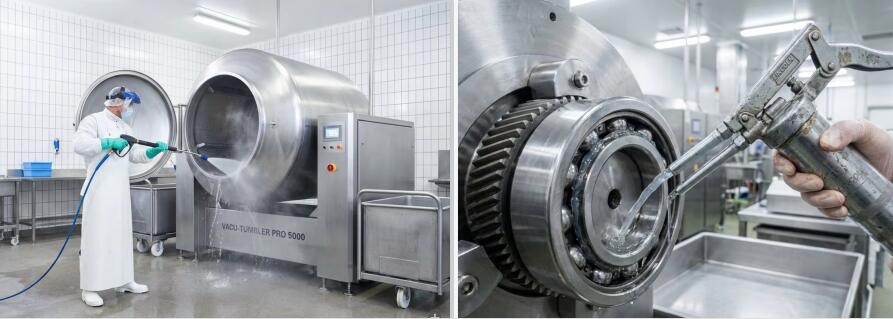
Pre-Rinse: Use warm water (approx. 45°C-55°C) to rinse off visible fat and protein. Avoid using boiling water initially, as it can "cook" the protein onto the metal.
Foam & Scrub: Apply an alkaline food-grade detergent. Let it sit for 10-15 minutes to break down fats.
Sanitize: Rinse and apply a sanitizer.
Dry: Crucial Step. Bacteria need moisture to grow. Ensure the machine is dry before reassembly.
Before hitting the "Start" button the next morning:
Check Safety Sensors: Test the emergency stop button and lid interlocks. The machine should never run if the safety guard is open.
Inspect Seals: Look for any leakage around the main shaft. If you see oil leaking into the bowl or meat juice leaking into the gearbox, stop immediately.
Even the best machines encounter hiccups. Here is a quick diagnostic table for common issues found in Meat Products Machines.
Problem | Possible Cause | Solution |
Machine won't start | E-Stop engaged or Lid open | Reset Emergency Stop; ensure lid is fully closed and sensor is aligned. |
Abnormal Noise | Worn bearings or loose chain | Check gearbox oil level; tighten drive chains; listen for grinding sounds (bearing failure). |
Weak Vacuum (Tumblers) | Clogged filter or worn seal | Clean the vacuum filter; inspect the lid gasket for cracks; check vacuum pump oil. |
Uneven Mixing | Overloading or worn paddles | Reduce batch size to rated capacity; check agitators for deformation. |
Hydraulic Lift Failure | Low oil or air in system | Check hydraulic fluid level; bleed air from the hydraulic cylinder. |
> Note: Always disconnect the power supply (Lockout/Tagout) before opening electrical cabinets or touching moving parts.
Daily cleaning keeps the machine safe; periodic maintenance keeps it running.
Greasing: Lubricate all grease nipples (bearings) with Food-Grade Grease. Do not over-grease, as excess pressure can blow out seals.
Vacuum Pump Oil: If you use a Vacuum Mixer or Tumbler, check the pump oil. If it looks milky (water contamination), change it immediately.
Drive Chain/Belt Tension: Chains stretch over time. Check the tension and adjust if necessary to prevent slippage or snapping.
Electrical Connections: Vibration can loosen wire terminals in the control box. Tighten all screw terminals to prevent arcing or short circuits.
Gearbox Oil Change: Drain and replace the gear oil. Old oil loses viscosity and contains metal shavings from wear.
Seal Replacement: Proactively replace the main shaft seals and lid gaskets, even if they look okay. Rubber degrades over time, and a failed seal can ruin a batch of meat.
Meat Processing Machine Maintenance Checklist
| Frequency | Maintenance Task |
|---|---|
| Daily | Clean meat residue, sanitize contact parts, check safety devices |
| Weekly | Lubricate bearings, inspect seals, check vacuum system |
| Monthly | Check belts, electrical connections and moving parts |
| Yearly | Replace wear parts and inspect gearbox |
When maintaining Meat Products Machines, you cannot use standard industrial oil. You must use H1 Registered Lubricants (Food Grade).
Why? In the event of an incidental leak where a drop of oil touches the food, H1 lubricants are non-toxic and tasteless. Using standard motor grease can result in a massive product recall and health code violations.
clean grinding plates
inspect blades
check motor temperature
check vacuum pump oil
inspect sealing gasket
clean drum interior
inspect paddles
check gearbox lubrication
Maintenance is not an expense; it is an investment. A well-maintained Meat Products Machine runs quieter, uses less energy, and produces a higher quality product.
By following a strict cleaning regime and a proactive lubrication schedule, you protect your production line from unexpected disasters.
Need spare parts or technical support?If your machine needs a new seal, a replacement blade, or a PLC upgrade, we are here to help.
Contact Tindo Tech Support or Browse Parts

Q1: How often should I change the oil in the vacuum pump?
A: typically every 500-1000 operating hours, or whenever the oil appears cloudy/milky. Moisture from the meat is the #1 killer of vacuum pumps.
Q2: Can I use a high-pressure washer on the machine?
A: Yes, for the stainless steel bowl and frame. However, never spray directly at the control panel (PLC screen), electrical motors, or bearing housings, as high pressure can force water past the seals.
Q3: My machine is vibrating excessively. What should I do?
A: Stop the machine. Check if the machine is level on the floor (adjust the feet). If it is level, check the internal mixing shaft—if the load is unbalanced or a paddle is broken, it will cause vibration.
The service frequency of a meat processing machine depends on the machine type, production volume, and working environment. For industrial meat processing equipment used daily, regular inspection and preventive maintenance are recommended.
Daily maintenance should include cleaning meat residue, sanitizing food contact parts, and checking for abnormal noise or vibration. Weekly or monthly inspections should focus on lubrication, wear parts, electrical connections, and safety components.
A proper maintenance schedule helps reduce unexpected downtime, improve machine performance, and extend the service life of your meat processing equipment.
A meat processing machine may stop working due to several common issues, including insufficient maintenance, worn components, electrical problems, or improper operation.
Common causes include:
Lack of regular cleaning causing meat residue buildup
Blunt blades or damaged cutting parts
Insufficient lubrication of moving components
Overloaded operation beyond machine capacity
Loose electrical connections or motor issues
Worn seals, belts, bearings, or other spare parts
Regular inspection and preventive maintenance can help identify potential problems before they lead to production interruptions.
To extend the lifespan of industrial meat equipment, manufacturers and operators should follow a preventive maintenance plan rather than waiting for equipment failures.
The most effective methods include:
Cleaning the machine thoroughly after each production cycle
Using the correct food-grade lubricants for moving parts
Replacing worn components before they affect performance
Checking blades, bearings, seals, and electrical systems regularly
Operating the machine according to the manufacturer's guidelines
Scheduling professional inspections when necessary
Proper maintenance not only increases equipment durability but also helps maintain stable production efficiency and reduce long-term operating costs.
Food processing machines should use food-grade lubricants that meet food safety requirements, such as NSF-certified H1 lubricants for areas where incidental food contact may occur.
The lubricant should be suitable for the specific machine components, including bearings, chains, gears, and other moving parts. Using the wrong lubricant may cause equipment damage, contamination risks, or reduced machine performance.
Always follow the equipment manufacturer's recommendations for lubrication type, frequency, and application method to ensure safe and reliable operation.


